Classic Bike Magazine - Flat Tracker T140 Engine Build... (Part 2)

Welcome back,

Triumph EngineIn the last brief introduction chapter, I talked about Rick Parkington (Classic Bike's very own mechanical marvel) arriving at SRM Engineering with the Triumph T140 Engine packed safely in a tea chest in the back of his Transit van. Well, needless to say we hauled the tea chest containing the Engine into the works in preparation for the booking in procedure and the initial all important visual check. (Every Engine that comes through our doors has to undergo this vital stage).

With every rusty and oily component removed from the chest and laid out on the work bench, it’s time to check exactly what there is and what’s missing from the engine (a more detailed examination will come later) it’s at this stage when we can fully ascertain – especially if the owners present – what may or may not be there.

Engine in a boxSo many engines arrive here at SRM Engineering - they come in all different guises. Some bound in small cardboard boxes which have a difficult time getting here. The owners have half stripped the engines, so there are always loose parts rattling about inside, others come bare (no wrapping) but complete and strapped to pallets, while other customers take the time to construct sturdy wooden boxes of the correct dimensions into which their pride and joy is to travel not only to our works but back again to their homes once the engines are finished and re-built. I wonder sometimes if the respective owners expect us to send back their completed engines on the same pallets and cardboard boxes in which they arrived!! I think not.

Classic Bike’s engine is no exception. With Rick eagerly looking on, Geoff our chief engineer and engine builder begins his visual and general check of the parts. Anything he spots is noted down for further analysis, while some of the more robust items he places back into the chest for safe keeping. When we’re all satisfied as to the condition of the engine, it’s then that Neil, another of our highly trained staff gets to book in the engine.

Every major piece of the engine is de-greased before being stamped or engraved with our own unique code. This code could be numbers or numbers and letters depending on the nature of work to be undertaken and again each part is inspected and measured for wear and thorough notes taken and a detailed estimate of the work is compiled and sent out. Everything is then returned to its box while we wait for the go ahead from the owner. No engineering work is started before this stage. As soon as we get the conformation, work begins and the relevant parts like the Crankcases, Crank, and Cylinders and head are sent to their relevant departments for further remedial work.

It’s important to follow the customer’s instructions to the letter, but on some occasions a follow up telephone call is required to inform the owners of an irregularity which has been overlooked. Things like a cracked crankshaft or a bent camshaft are found on occasions and it’s part of our Company policy to inform customer of any irregularities found. Customers always have the final control over what costs are involved.

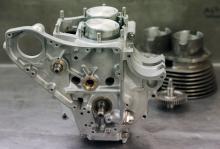
The crankcases are stripped of all studs, bearings and grease before being fitted with appropriate rubber bungs and plugs, and then readied for bead blasting. Not all customers require the cases to be cleaned, but this is a worthwhile step in my opinion. A properly cleaned crankcase looks exactly the same as it left the factory so many decades earlier.

The crankshaft undergoes the same treatment. The sludge tube is removed along with the plugs, then thoroughly cleaned and de-greased. We then check the crank for hair-line cracks to the journals and mains using our Magnetoscopic crack detector. These cracks show up under ultraviolet lights as very thin pencil like lines which sometimes run the entire length of the affected journal. It’s very rare to have both journals cracked. The only remedy for a cracked crank is to replace it. Even SRM can’ fix this!!

Once the crankshaft has passed this stage it’s time to grind the main journals using our Prince Crankshaft grinder. Andrew Hill (Engineer and Rolls Royce trained) is highly qualified and charged with this stage of work, in the case of Classic Bike’s T140 motor, the main journals only need a fine polish before being passed as serviceable. If there’s any engineering work to be done to the crankshaft, now is the time to do it before the whole assembly is taken and prepared for dynamic balancing, but not before the cylinder bores are measured to ascertain whether new pistons are to be used. The connecting rods are also examined and measured for wear. Big end failure or partial seizure of the pistons in an engine can seriously damage the housings of the rods or the small end bush and in severe cases the housings cannot be reclaimed and new rods have to be used. Bear in mind the majority of original conrods are now nearly 40 years old, some much older, and as we know, age plays a vital part in the deterioration of material. Therefore even the big end nuts and bolts need renewing as a matter of course.

When we’ve decided on all relevant parts, everything gets prepared for balancing out the crankshaft. The shells get weighed to the nearest gramme; Big end and small end housing weights together with the individual piston weights are recorded along with the overall weights of each individual rod. Calculations are then made for each rod, paying attention to the balance factor used for each different design of engine. A wrong balance factor renders the whole operation void, and could result in a significant vibration increase and a deterioration of engine performance.  Special weights are added to the main journals of the crankshaft which represent the weights of the rods and pistons. The assembly is then placed on knife edge rollers which then indicate to us where the heaviest weight is. Material is then removed from the flywheel until the crankshaft can spin effortlessly between the knife edge rollers and can stop in any position. This is referred to as the Static balance stage. The next stage is to mount the whole assembly to our Borgo Crankshaft balancing machine; the whole assembly is then spun at various speede in order to record the vibration which occurs between the shafts of the crank itself. This is called the Rocking couple, and it’s surprising how out of balance every crank is. The crankshaft sits on its drive and timing side journals on special tremblers that record the amount of vibration travelling through them. These readings are then displayed on the machine and it’s the operator’s task to record these measurements before removing the excess weight form each position. The whole operation gets repeated several times until the readings reach zero. The crankshaft is now Dynamically balanced and needs no further work.

Back in the workshop, Geoff is busy with the rest of the engine, but we’ll elaborate more on this in our next instalment of Classic Bike’s T140 flat tracker engine…

Watch this space and have a Very Merry Christmas!!